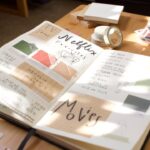
The Ink That Mends: Finding Healing in the Words We Dare to Write
The Ink That Mends: Finding Healing in the Words We Dare to Write
When the Wound Becomes the Page
I want to start with something honest: healing is not a straight line. It never was, and nobody told me it would feel so much like wandering through a room with the lights off, hands stretched out, hoping to find something solid. I learned this not from a therapist’s office or a self-help book, but from a journal I almost did not buy. A simple, cloth-covered notebook that sat on a shelf in a little shop while I stood there, grieving something I could not even name yet.
I bought it anyway. And something shifted.
That first page terrified me. Blank white space has a way of doing that — of holding up a mirror before you are ready. But I pressed the pen down, and I wrote one word: tired. Just that. And somehow, that single word cracked something open inside me that years of silence had sealed shut.
What Healing Actually Looks Like
We live in a culture that wants healing to look triumphant. We want the before-and-after, the breakthrough moment, the single poem that saves a life. And while those moments exist — I have had a few of them myself — most healing is quieter than that. Most healing looks like sitting down with your notebook on a Tuesday morning when you would rather disappear, and writing anyway.
It looks like a sketch you make in the margins that you think means nothing, until three weeks later you realize you drew yourself finding your own hand.
“The wound is the place where the Light enters you.” — Rumi
I return to that line often. Not because it makes pain romantic, but because it reminds me that the places we break open are also the places we begin to see. Writing and art give us a way to look directly at those openings without flinching — or if we do flinch, at least we are looking.
The Science of Spilling It onto the Page
Why Expression Heals
There is research behind what many of us already feel intuitively. Psychologist James Pennebaker spent decades studying expressive writing and found that when people write about emotionally significant experiences — especially difficult ones — their physical and mental health improves. Their immune function strengthens. Their anxiety decreases. Their relationship to painful memories begins to change.
What strikes me most about this research is not the clinical data, but the reason it seems to work: when we write our pain, we are giving it a shape. We are taking something formless and terrifying and we are saying, here, I see you, I am naming you. That act of naming is one of the most ancient forms of power we have.
Art as a Second Language for Pain
But what about those of us for whom words feel like too much? There are days when language is simply not available — when the grief or the anxiety or the numbness sits so deep that sentences feel like strangers. This is where art steps in. A brushstroke. A collaged image torn from a magazine. A doodle that becomes a labyrinth that becomes a meditation.
I have learned to trust the ink even when I cannot trust the words. Sometimes I draw spirals for twenty minutes and emerge feeling lighter, without knowing exactly why. The body knows things the mind has not caught up with yet, and art gives the body permission to speak first.
Starting Where You Are
You Do Not Need to Be a Writer or an Artist
This is something I want to say clearly, because I know how many people arrive at the idea of expressive writing or journaling and immediately feel disqualified. They think: I am not creative enough. My handwriting is terrible. My feelings are not poetic. My life is not interesting.
Let me tell you something I deeply believe: your life is interesting. Your feelings are valid. Your handwriting is irrelevant. And creativity is not a talent you either have or do not have — it is a practice. It is showing up. It is putting ink on a page and deciding, just for this moment, that what is inside you is worth externalizing.
You do not need to write beautifully. You need to write honestly. Those are very different things, and only one of them heals.
Small Rituals, Lasting Change
If you are new to healing through writing and art, I want to offer you something simple. Not a program. Not a curriculum. Just an invitation.
Find a notebook — any notebook, a cheap one is perfectly fine. Find a pen that feels good in your hand. Set aside ten minutes, just ten, and write at the top of a fresh page: What I have been carrying lately is… Then let whatever comes, come. Do not edit it. Do not cross things out. Do not read it back yet. Just let it pour.
“There is no greater agony than bearing an untold story inside you.” — Maya Angelou
That untold story deserves a place to land. Your journal is that place. Your sketchbook is that place. Even a napkin with a few scrawled words is that place. The medium matters less than the act of release.
Healing Is Not the End of the Story
I want to close with this: healing is not a destination you arrive at and then stop. It is something you practice, the way you practice breathing, the way you practice love. Some days you will feel mended. Some days the old ache will return and you will wonder if any of it worked at all.
On those days, I hope you come back to the page. I hope you pick up the pen or the brush or the colored pencil and you make something — anything — because the act of making is itself an act of faith. It says: I am still here. I am still trying. I still believe that something beautiful can come from this.
That is what ink to mend means to me. Not that writing fixes everything. But that it keeps us in conversation with ourselves — tender, honest, and alive.
With love and a full inkwell,
Hanan